By Bob Cummins, the Founder and CEO at Sodak

This is the second in a series of articles by Bob Cummins, founder and CEO of Sodak, exploring why safety culture needs to move beyond personal responsibility to collective accountability. In Part 1: Risk is Multiplied, Not Contained, Bob examined how risk radiates outward through organisations – and how tolerating small breaches creates the conditions for serious incidents. Here, he turns to the idea of “personal responsibility” itself, and asks whether it’s doing more harm than good.

Part 2: The Illusion of Personal Responsibility

The dominant narrative in safety has long been about personal responsibility. “Look after yourself. Make the right choice. Don’t cut corners.” It’s neat, it’s simple, and it feels empowering. But it’s also deeply flawed.

There are two main problems.

Problem 1: Injury is never just personal

At work, no injury is ever suffered in isolation. Consequences ripple outward – from the worker to their gang, their supervisor, their manager, the client, the subsidiary, the group. Even the language we often use – “that’s his risk,” “that’s her choice” – doesn’t hold up under scrutiny.

If one person’s “personal choice” causes the whole gang to down tools, is it still personal? If the project deadline slips, the client relationship suffers, and a subsidiary director loses future contracts, is it still personal? If investors question the resilience of the group and share price wobbles, is it still personal?

Every injury, every act of non-compliance, is shared. The impact is collective, even if the trigger looked individual. And crucially, even when no injury occurs, repeated tolerance of “personal choices” builds a shared vulnerability. A supervisor who ignores one unclipped harness today makes it harder to enforce rules tomorrow. A board that waves away minor breaches in monthly reports is quietly writing permission slips for the next major incident.

Problem 2: Choices are never made in a vacuum

We like to imagine that workers freely “choose” whether to comply or not. But human behaviour is not made in a vacuum. It is shaped by environment.

Consider these forces that act on behaviour:

  • Time pressure: When deadlines are unrealistic, people are nudged to take shortcuts.
  • Peer behaviour: If the gang tolerates shortcuts, new joiners copy what they see.
  • Supervision: If supervisors look the other way, tolerance becomes normalised.
  • Tools and equipment: If the right PPE isn’t readily available or comfortable, workers improvise.
  • Consequences: If unsafe acts are never challenged, they are silently reinforced.

In short, people respond to the environment around them. That’s not weakness, it’s human. Behavioural science shows us that environments exert far more influence than abstract notions of “personal responsibility.”

And here’s where tolerance links back in: every time a leader signs off a report full of “minor” breaches without acting, they create the environment that shapes future behaviour. Every unchallenged act is not just permitted, it is reinforced. The worker doesn’t see themselves as “choosing risk,” they see themselves as doing the job the way everyone else does it.

This is why “personal responsibility” is an illusion. It hides the truth: the causes of unsafe behaviour are systemic, and the consequences are collective.

Yes, individuals carry responsibility. But if that’s the only frame we use, we miss the bigger picture – and we allow leaders to abdicate theirs. Telling a worker “it’s your responsibility” is, in many cases, simply passing the buck.

Personal responsibility is the weakest shield we can give people. Collective responsibility is far stronger – shaping environments, setting higher standards, and refusing to tolerate small risks that ripple outward.

By Midori Nishioka, Principal Behavioural Scientist at Social Machines and Lead Behavioural Scientist at Culturlabs

Most cross-cultural research in organisations has focused on cultural differences between countries, but the underlying principles might still be useful for other sources of culture (e.g., religion, gender, occupation, team). 

Before diving into what the evidence says, though, the first thing to recognise is that culture may not always be important. An analysis of key national culture dimensions that aggregated nearly 600 studies showed that while national culture often impacts employee outcomes like workplace behaviours, attitudes, and performance, an employee’s personality and abilities are sometimes equally or more important.  

So, when does culture matter, and how should we account for it? We can break down insights from cross-cultural research in the following ways: 

  • Universality: Some things are nearly universally good or bad. In such cases, you might not have to account for cultural differences. 
  • Congruence: Sometimes you might want to adapt your practices to match the employees’ cultural expectations and norms. This is what most people think ‘accounting for’ different cultures means. 
  • Incongruence: An approach that is different from your employees’ culture isn’t necessarily bad, and might in fact be welcomed.  
  • Multiculturalism: Beyond specific cultures, there are practices that are particularly effective for culturally diverse teams. 

Let’s dive into each of these in more detail and with practical take aways.  

Universality 

Despite our differences, people have quite a lot in common. Some workplace practices are regarded positively in most cultural settings, while others are widely seen as harmful. This means that you can often depend on these ‘near-universals’ regardless of your employees’ cultures. 

Multinational enterprises (MNEs), while accounting for differences in cultural practices and norms across different regions in which they operate, still maintain cohesion and standardised practices. In one case study, an MNE developed an employee idea suggestion scheme from  their US operations and rolled it out globally without making any changes to it. Even in places where employees voicing their opinions might be seen as counter-cultural, the initiative yielded useful suggestions. The fact that many MNEs successfully implement global initiatives tells us that not everything needs to be culturally specific. 

Some leadership styles are also universally effective. Studies (including a large-scale study of 24 countries) showed that ‘transformational leadership’ enhances employee performance, innovation, and commitment across cultures. Transformational leaders are grounded in their convictions, inspire with vision, stimulate creativity, and attend to  employees’ needs. ‘Servant leadership’ is also linked to better employee performance, creativity, and employees going ‘over and above’ what’s required. Servant leaders are driven by empathy and altruism, and puts the needs of their followers and the wider community first. By contrast, unsurprisingly, ‘abusive supervision’ – characterised by sustained hostility and demeaning behaviours toward employees – is associated with worse employee outcomes across countries, including lower job satisfaction and poorer attitudes toward the supervisor.  

Beyond individual initiatives and leadership styles, certain HR systems seem to work well across cultures. An analysis of over 35,000 firms across 29 countries found that ‘High Performance Work Systems’ (HPWS) were consistently beneficial to firm performance. HPWS is a set of HR practices designed to enhance employee ability, motivation, and opportunity to contribute – for example, through selective staffing, investments in training, pay-for-performance incentive structures, and employee participation in decisions. 

What this means in practice: You don’t need to customise everything. Wherever you are, you can incorporate basic principles like considering employees’ needs, investing in their growth, and encouraging creativity. However, the exact implementation of an initiative might need to be adapted to the local context – which brings us to ‘congruence.’ 

Congruence 

Congruence is what most people usually have in mind when they talk about accounting for culture: adapting your approach so that it better fits employees’ cultural expectations and norms. A large body of research suggests that this intuition is often correct.  

One potentially important difference across cultures is where they’re placed on the individualism-collectivism continuum. In simple terms, it’s about whether people define themselves as ‘me’ or ‘we’ – individualist societies (like the UK) tend to have an expectation that each person takes care of themselves and their loved ones only, whereas in collectivist societies (like India and China), people belong to a group that they depend on, and contribute to.  

These differences can matter in the workplace. People in individualistic cultures tend to feel more confident in their abilities from personal feedback, whereas people in collectivistic cultures also benefit from group feedback. Relatedly, in collectivistic cultures, it’s important for a person’s group to have control, whereas people in individualistic cultures focus on personal control. And even though going along with the group when there’s peer pressure is a universal phenomenon, some research suggests that the tendency to conform to the group is stronger in collectivistic cultures than individualistic cultures. 

Another cultural dimension that seems to matter, particularly for leadership, is power distance. Power distance is about societal expectation and acceptance that power is distributed unequally across people. Whereas ‘abusive supervisors’ are unpopular across the world, in low power distance cultures (where people don’t expect or accept unequal power), employees respond particularly negatively to such supervisors. 

What this means in practice: The aims and main features of your work initiative might not need to change, but keeping in mind some of the key cultural dimensions can help you adapt to the employees’ cultural context. For example, if your organisation aims to instil a sense of confidence and control – across individualistic and collectivistic cultures – perhaps your initiative can strategically incorporate personal and group-based feedback and emphasise personal and group-based control. 

However, there’s also evidence that counter-cultural practices can stimulate innovation, bringing in fresh ways of doing things. This brings us to ‘incongruence.’ 

Incongruence 

Different cultural practices and beliefs can complement one another and stimulate change in ‘how we’ve always done things.’  

Research on firms operating outside of their country of origin shows that ‘foreignness’ can sometimes be an advantage, such that these firms can achieve better innovation than local firms, distinguishing themselves from their competitors. The oddity of outsiders can be turned into curiosity and creativity. 

Inside the walls of the organisation, some research shows that leadership styles that don’t quite ‘fit’ the country’s culture can be effective. For example, one might assume that cautious leaders that don’t take risks would be favoured in cultures with high uncertainty avoidance – places where people want predictability and don’t like surprises – like Japan and France. In contrast, research shows that in these cultures, charismatic and transformational leaders – visionaries who emphasise breaking the status quo – are particularly effective at enhancing employee effort and innovation.  

Multiple studies have also shown that in collectivistic countries, HPWS, which tends to incorporate individualised pay-for-performance schemes, are actually beneficial for employee performance. Employees in high power distance cultures also respond positively to more egalitarian practices like employee opportunities to voice their opinions and participate in decision-making – despite the prevalent acceptance of unequal power distribution in these cultures. 

What this means in practice: The lesson here is that lack of cultural fit does not automatically mean failure. In fact, sometimes employees might welcome your counter-cultural approach. If you’ve spotted elements of your work initiative that seem to conflict with the employees’ culture, ask yourself whether these elements might in fact offer something that employees would value – like a solution to a long-standing problem or permission for them to explore new ways of doing things. 

Multiculturalism 

We’ve been talking about employees as if they all have the same cultural background, to which you respond with universal, congruent, or incongruent strategies. But increasingly, people are working in culturally diverse teams, with employees from different backgrounds working side-by-side. What should you do when there are clear cultural differences among your employees? 

Research has shown that one key to success for multicultural teams is in communication. When leaders help to prevent communication breakdowns and help team members to share knowledge, culturally diverse teams can perform equally or better than culturally homogenous teams. Similarly, leaders with wide-ranging cultural experiences tend to be effective communicators, which in turn contributes to team performance; this positive impact of leadership on performance is particularly strong when teams are culturally diverse. Finally, one study found that when team leaders proactively get their team to work together toward a shared goal, team members make an effort to communicate in a way that others on the team would understand. Again, the impact of leadership on communication among the team was stronger among teams that were more culturally diverse. 

What this means in practice: Conflict and misunderstanding are genuine concerns when people are coming from different systems of values, beliefs, and practices. However, if you’re in charge of a work initiative, you can play a critical role as a leader by communicating clearly and supporting the flow of information among employees. And the more you work across diverse cultural contexts, the better you might get at it! 

Conclusion 

Put together, these four ideas lead to a practical answer. Start with a universal core – at the end of the day, we’re all people, who want to be treated with dignity, our needs considered, and our voices heard. Around this core, build congruence in how initiatives are communicated and implemented, so that they make sense to different cultural groups. But don’t assume that incongruence is always bad; some practices that seem counter-cultural to your employees may be exactly what you need. Finally, you can turn the challenge of multiculturalism into an opportunity by helping diverse teams communicate well and rally around a shared goal. 

References 

Aguinis, H., & Henle, C. A. (2003). The search for universals in cross-cultural organizational behavior. In J. Greenberg (Ed.), Organizational behavior: The state of the science (2nd ed., pp. 373–411). Lawrence Erlbaum Associates Publishers. 

Caprar, D. V., Kim, S., Walker, B. W., & Caligiuri, P. (2022). Beyond “doing as the Romans do”: A review of research on countercultural business practices. Journal of International Business Studies, 53(7), 1449-1483. 

Den Hartog, D. N., & De Hoogh, A. H. (2024). Cross-cultural leadership: What we know, what we need to know, and where we need to go. Annual Review of Organizational Psychology and Organizational Behavior, 11(1), 535-566. 

Gelfand, M. J., Erez, M., & Aycan, Z. (2007). Cross-cultural organizational behavior. Annual Review of Psychology, 58(1), 479-514. 

Lisak, A., Erez, M., Sui, Y., & Lee, C. (2016). The positive role of global leaders in enhancing multicultural team innovation. Journal of International Business Studies, 47(6), 655-673. 

Lu, J. G., Swaab, R. I., & Galinsky, A. D. (2022). Global leaders for global teams: Leaders with multicultural experiences communicate and lead more effectively, especially in multinational teams. Organization Science, 33(4), 1554-1573. 

Taras, V., Kirkman, B. L., & Steel, P. (2010). Examining the impact of Culture’s consequences: A three-decade, multilevel, meta-analytic review of Hofstede’s cultural value dimensions. Journal of Applied Psychology, 95(3), 405–439.
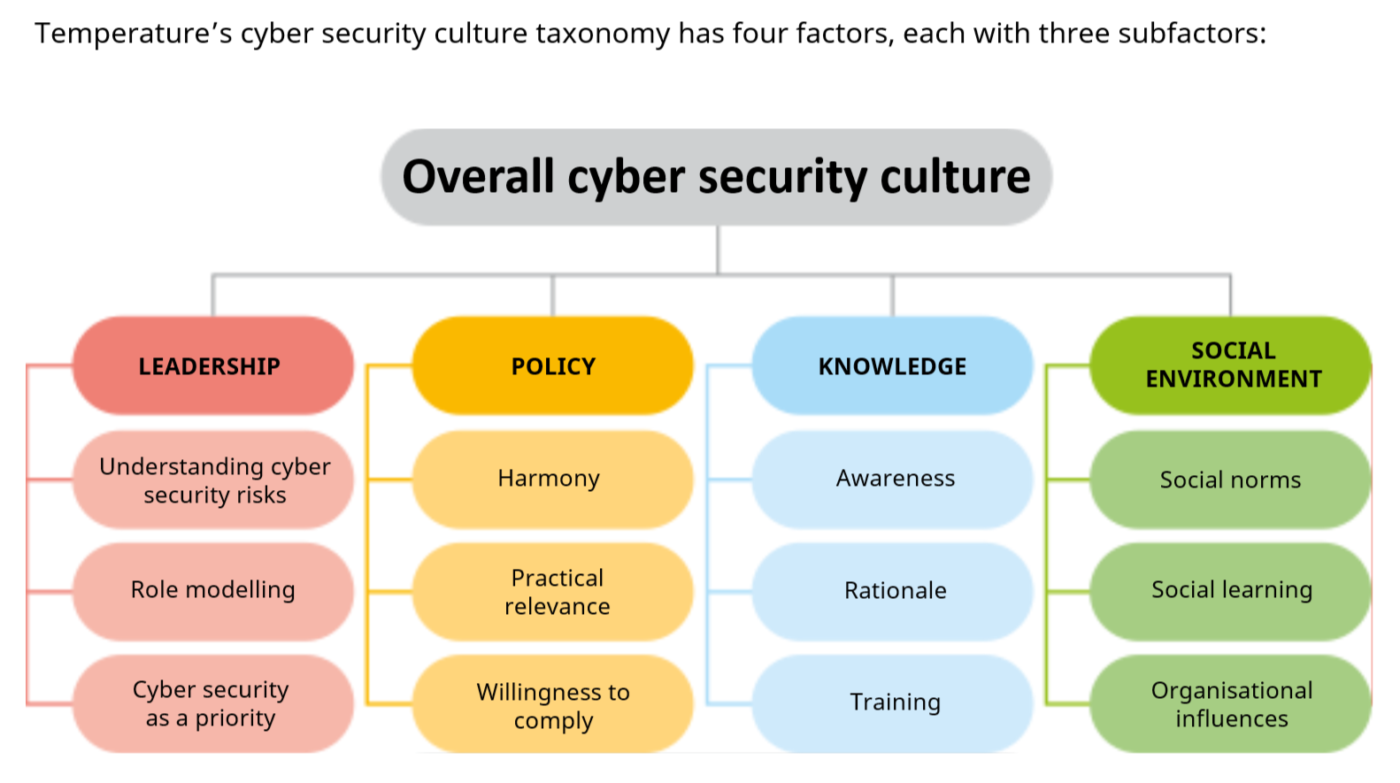
Temperature is our evidence-based culture measurement and improvement platform.

Its first application focuses on cyber security culture: what employees think, feel, and do when it comes to cyber security in their organisation. Our team of behavioural scientists and psychologists have developed a practical measurement taxonomy.

Each of these cultural factors were identified, and then iteratively refined using a variety of data sources and techniques:

  • Academic and industry literature review.
  • Stakeholder engagement and pilot testing.
  • Definition refinement and review.
  • Qualitative and quantitative analyses for validation.

We are always gathering new data and insights to refine the taxonomy. We do this by working with a diverse group of industry practitioners and academics.

Let us know if you’d like to find out more about our cyber security culture taxonomy. Contact us at: hello@culturlabs.com

By Bob Cummins, the Founder and CEO at Sodak

Part 1: Risk is Multiplied, Not Contained

When we talk about risk, we often talk about it as though it sits neatly within the individual. One worker, one action, one outcome. But that’s not how risk actually behaves. Risk multiplies. It radiates outward.

Think about a worker at home, tinkering in their garage, doing DIY without eye protection. If something goes wrong, who suffers? Mainly the individual. The ripple is small – they may lose a day’s work, their family might take on the burden of care, and perhaps their employer is short a worker for a short time. Still, the circle of consequence is tight.

Now, move that worker onto a site with a gang of ten. The same act – working without protection – carries a completely different set of consequences. If they’re injured, the gang stops work immediately. That’s lost time, a dent in productivity, and an emotional impact on colleagues who’ve just watched their mate get hurt. The supervisor is pulled away from leading the work to deal with paperwork, investigations, and the fallout.

At the level of a contracts manager, that one injury may delay a project. Deadlines slip, the client is frustrated, penalties could be triggered. And if that client happens to be a repeat customer, their trust in the company weakens.

Go up another level: the subsidiary director. They now have another incident on their books. Their record of performance against safety KPIs is dented, their ability to win new contracts is weakened. They might face difficult questions in monthly reviews or from the board.

And if the company is part of a wider group? A single serious incident doesn’t just stay with the subsidiary. It lands on the group’s annual report. It can attract regulator attention, unsettle investors, and, in the case of listed companies, knock share price. Clients don’t usually make a neat distinction between one part of a group and another. If one brand in the group falters, confidence in the group as a whole suffers.

So risk doesn’t stay in a box. It doesn’t stop neatly at the level where it happened. The bigger the organisation, the further the ripple runs.

But it’s not only big accidents that ripple outward. So does the tolerance of small ones. A worker wearing glasses pushed up onto their helmet instead of over their eyes, a guard left off a machine, a lanyard unclipped “just for a moment.” These don’t trigger headlines. They often don’t cause immediate harm. But tolerated month after month, they quietly build a culture that says “this is normal.”

For a small contractor of five people, the cost of such tolerance is contained: it may increase the odds of one person getting hurt, but the fallout is local. In a group of 10,000 employees, those same acts multiplied across hundreds of sites become systemic risk. When leaders shrug at “minor” breaches in monthly reviews, they signal that breaches don’t matter. And when a serious incident does happen, they’ve already created the conditions for it.

In other words: as organisations grow, the multiplier on risk grows with them. What once looked like a personal decision now looks like an organisational vulnerability. What once was tolerable in a five-person outfit becomes catastrophic in a multi-subsidiary group.

This is the first lesson: risk is multiplied, not contained – by scale, and by tolerance.

Culture is a living entity that is always there, whether you try to shape it or not. Here are five things to get you started on your culture change journey.

  1. Clarify the need for change. You’re probably thinking about culture change because there are problems at your organisation. But ask yourself: Setting culture aside for a moment, what needs to change to solve those problems? What do people need to learn and unlearn? Culture change is a long and difficult journey. It’s not something you start for its own sake. It should serve a purpose.
  2. Get leaders to commit: Leaders are crucial in setting the direction and modelling the right behaviours. They need to be convinced that the problems exist, that changes are needed, and that they need to be active participants in the change. In practice, this means getting leaders to articulate the problems themselves, commit to going through an uncomfortable unlearning process, and model new behaviours.
  3. Understand your culture. Once you know what needs to change at your organisation, let’s consider culture: What is your organisation’s culture right now? Talk to people across your organisation. Use a quick survey to get a picture of what’s going on. Organise group discussions and ask people what they think the culture is like. Don’t stop at collecting information about what people do. Dig deeper: Why do they do what they do? Do the “values” of the organisation match or conflict with what people are doing?
  4. Decide on culture change: Sometimes the existing culture (once you understand it) actually helps you solve the problems, and you don’t really need a culture change! Other times, you’ll start seeing how elements of the existing culture is a blocker to making the necessary changes. Have discussions with people in the organisation – including leaders, of course – on what specific aspects of culture needs to change, if at all.
  5. Support the change: Culture change often requires people to learn new ways of thinking and working. If there are clear set of behaviours for people to adopt, leaders should model them. If it requires trial and error on the part of each person, people will need to be given the incentives and structures to figure out what works for them. Learning new things are often difficult – everyone needs to be given the space to make mistakes, trouble-shoot, receive feedback, and be rewarded when they’re going in the right direction. Share quick wins with everyone. People are much more likely to get on board when they see the benefits of the new ways of doing things.

Culture grows strongest when people feel like they’re part of the journey, not just watching it happen. Sharing progress openly, and celebrating wins, will help make sure everyone feels involved. Ultimately, building a positive culture is an iterative process that begins with self-awareness – understanding what your culture is, why it exists, and how the organisation’s systems can be tuned to produce the results you want.

There is a genuine concern that the word ‘culture’ is often used without a clear understanding of its real impacts on the business and on staff. Culture is, by nature, intangible, and this creates problems when the term is overly relied upon. It has become a catch-all explanation for everything that goes wrong, from low engagement to ethical lapses. People talk about ‘culture issues’ as if culture itself is to blame.

The components of culture – values, beliefs, assumptions and norms – matter, but they don’t stand alone. They are shaped by the systems, structures, and leadership behaviours around them. Saying that there’s a problem with the ‘culture’ can shut down inquiry into the real causes of the problems that the organisation is facing, like the leadership decisions and structural conditions that produced those behaviours (Hopkins, 2018). Over-focusing on culture risks wasting time and energy when the real problems sit elsewhere.

Some leaders might talk about culture without embracing their responsibility – to build and maintain the systems and structures that give rise to the culture, and to model the behaviours that align with the desired culture themselves. Moreover, they might treat culture change as just another communication exercise. But culture does not shift because a new slogan or narrative is introduced. It changes when systems change, when norms are demonstrated consistently through actions, and when leaders don’t just drive the change but live it themselves.

The danger of misunderstanding culture becomes evident when you look at the gap between actual and purported culture. Recent research from Nottingham Trent University (2024) surveyed 1,170 UK managers and employees. Only 18% felt their organisation’s stated values matched its real culture, and a quarter reported that leaders’ behaviours directly contradicted those values. It’s no surprise that this mismatch leads to loss of trust, disengagement, and lower performance. In fact, erosion of trust is strongly linked to burnout and higher turnover among employees. This reinforces the idea that misusing the term ‘culture’ obscures the real drivers of employee experience, and blaming culture without questioning what that means can compound issues rather than solve them.

In short, culture should be seen as a mirror reflecting what an organisation’s people, systems, incentives, and everyday actions produce. If we focus only on trying to change the reflection, we miss the mechanisms behind it. To truly understand culture’s impact, and to avoid misusing the term, leaders need to concentrate less on talking about culture and more on designing the conditions that allow the right one to emerge.

Nick (the director at Culturlabs) was recently chatting with a Chief Information Security Officer at a mid-sized organisation. There, cyber security awareness meant running monthly phishing simulations.

They logged which employees ‘failed’ their phishing simulations and every first Friday of the month, the security team sent out the list of employees who had ‘clicked’ most often. This organisation is not alone in taking this kind of approach. A common response to cyber risks is to identify ‘high risk’ staff and to provide more tailored, relevant training.

But during the conversation, it became clear that the names on the monthly lists were typically not the same employees. What does that tell us? Whereas some employees may be consistently vulnerable, only focusing on changing their behaviours misses the broader picture. Even well-intentioned, informed staff can make mistakes if the system sets them up to fail. If the list of names changes month after month, it prompts us to look beyond individual blame and consider what aspects of the system make these behaviours more likely.

So, let’s talk about system change a bit.

First of all, what is a system? A system is a set of interconnected elements that are organised in a way that achieves something (Meadows, 2009). An organisation in any industry or sector is by definition a system, because it has elements (e.g., people and information) that are interconnected (e.g., people access and exchange information with each other), and it has a purpose (e.g., sell or provide a product or service). System change is – put simply – the process of changing the system (Hacking, n.d.).

With a systems lens, it becomes obvious that there is more to human risk management than changing a person’s behaviour through training. For starters, people care about what others think. A large-scale survey of over 1,000 employees across Germany, the UK and the US found that employees report suspicious emails more often the more they feel that their peers and managers discuss, prioritise, and pay attention to information security (Petrič & Just, 2025). Many similar studies show that employees’ perceptions of their managers and how security is communicated are key drivers of employee compliance and cyber risk awareness (Flores & Ekstedt, 2016; McKnight & Warkentin 2020). In short, a person’s behaviour doesn’t occur in a vacuum; what’s happening in their social environment influences the person, and vice versa. Together, they form a system that’s more than the sum of its parts.

This doesn’t mean we should throw behaviour-focused approach in the bin! In a manifesto for using behavioural science to address important problems of today, Dr Michael Hallsworth – Chief Behavioural Scientist at Behavioural Insights Team – says that targeted behaviour change can be made a lot more effective by embracing the complexity of systems (Hallsworth, 2023). Complex systems can produce wide-ranging outcomes from smaller, lower-level processes. For example, an organisation’s culture is not just defined and created by leaders but emerges from the day-to-day interactions among its employees. And within these social networks are a handful of people who are influential (think of that colleague whom everyone likes and respects). Behavioural science can help identify and target such leverage points and design interventions – perhaps these ‘influencers’ could champion security within their own network (Alexander et al., 2022; Jaatun & Cruzes, 2021).

So, stop getting too bogged down on the list of employees who ‘failed’ phishing simulations. Step back and start asking how the system reinforces their behaviours. What can you do to shape the system so that cyber security comes easily to everyone? This is a tough question for anyone to answer – and that’s why we want to help you tackle it.